
 Services
Our Services
Professional Floor & Tiling Nottingham
From large-format porcelain tiles to engineered hardwood and luxury vinyl, we lay every floor to perfection. Our tilers work to tight tolerances with perfectly level finishes — no lippage, no grout lines that wander. Your floor, done right.
What's Included
Preparation decides the finish
A tiled floor is only as flat as what it is laid on, and tiles have become much less forgiving. A 600mm by 1200mm porcelain tile will telegraph a hollow that a 300mm tile would have bridged, and the result is lippage: one tile edge standing proud of its neighbour. You feel it barefoot before you see it, and once the adhesive has gone off there is no fixing it without lifting the floor.
So the floor gets levelled first, with a self-levelling compound or a screed, not corrected with extra adhesive. Building a tile up on a thick dab of adhesive leaves a void underneath, and a void under a tile is where cracks start.
Timber floors move
Most Nottingham terraces and semis have suspended timber ground floors and timber upstairs. Timber deflects underfoot, and rigid tile laid on a deflecting floor cracks along the grout lines. The fix is to stiffen the deck first: an overlay board or ply of adequate thickness, screwed at close centres, and then a decoupling membrane between board and tile so small movements are absorbed rather than transmitted. Skipping the membrane to save a day is the reason plenty of tiled floors in older houses have a crack running across them.
Tiles, adhesive and the details that get skipped
- Full coverage. Floor tiles should be laid to solid bed coverage, back-buttered on large formats. Five dabs on the corners is a wall technique and it fails on a floor.
- The right adhesive. Porcelain is non-porous and needs an adhesive rated for it. Natural stone needs one that will not stain through the tile. Underfloor heating needs a flexible grade.
- Movement joints. A large tiled area, and any tiled floor over heating, needs perimeter and intermediate movement joints. They are invisible when done properly and they are what stops a floor tenting in summer.
- Grout joint width. Rectified large-format tiles allow a narrow joint, but not a nonexistent one. A joint too tight has nowhere to take slight size variation between tiles and the courses drift visibly.
Choosing by room
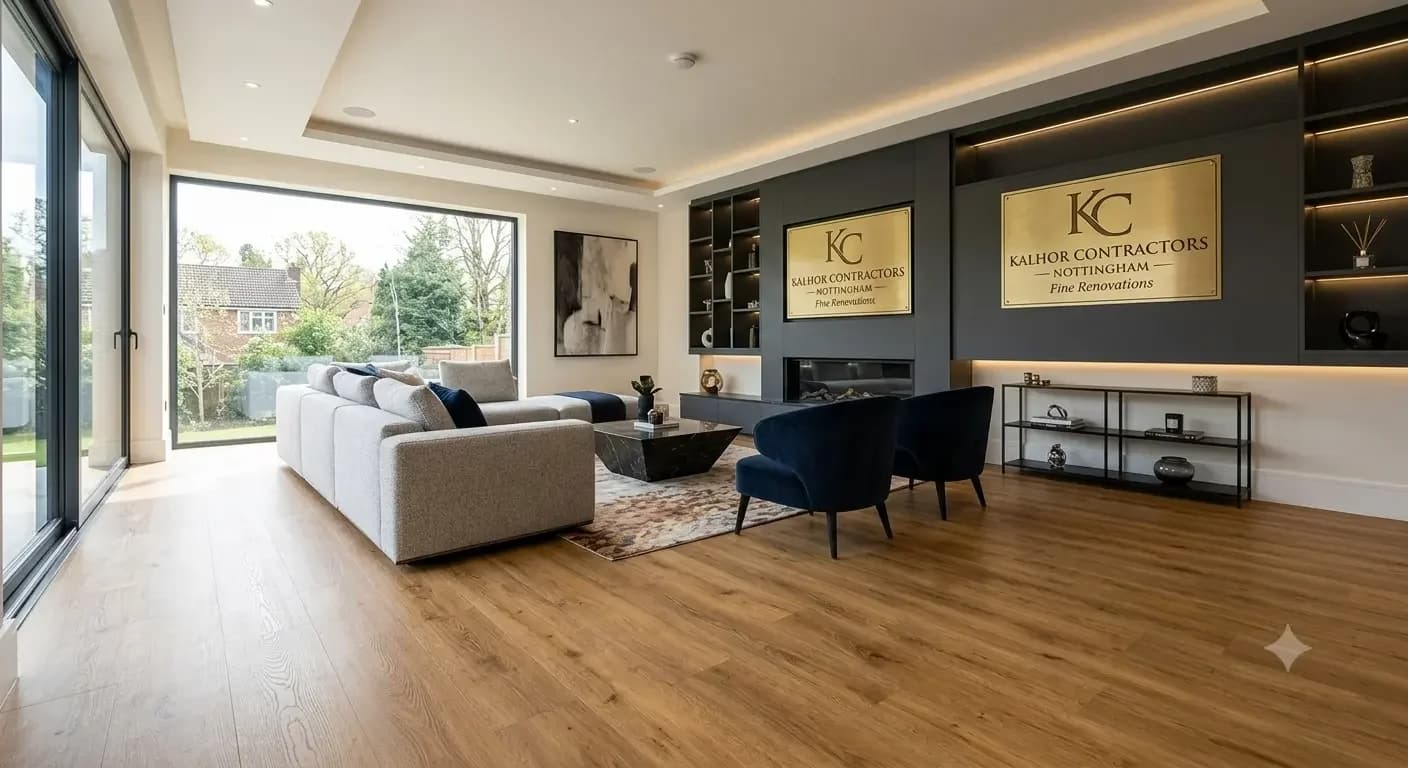
Kitchens and hallways take the most punishment, and large-format porcelain or a good LVT both handle it; porcelain is harder, LVT is warmer and quieter underfoot. Bathrooms and wet areas need a slip rating suitable for use when wet, which usually means R10 or better, and small formats or textured surfaces inside a shower where the grout lines themselves add grip. Living rooms and bedrooms suit engineered wood: solid timber moves too much in a centrally heated house, whereas an engineered board with a real wear layer over a stable core stays put and works over underfloor heating.
Herringbone and chevron are worth the extra labour in a period property, and they need setting out from a centre line rather than started from a wall, or the pattern runs out of square across the room.
Two things people skip
Acclimatisation. Wood and LVT need days in the room they are going into, at the temperature they will live at, before fitting. Fitted straight off a cold van, they shrink or expand afterwards and open gaps.
Expansion gaps. Timber and floating floors need a perimeter gap, hidden under the skirting or beading. A floor fitted tight to the walls has nowhere to go and lifts in the middle.
What drives the cost
Preparation more than anything: a floor needing levelling, overlay boarding or an old covering removed costs more than the tiling. Then tile format (large formats are slower and need two people), pattern, the amount of cutting around obstacles, and underfloor heating.
We can supply through trade suppliers or fit material you have chosen. Either way, order 10 percent over for cuts and future repairs, from the same batch. Free site visit, fixed price, 12-month guarantee.
The Look
FAQ
Common Questions
Both options work. We can source tiles through our trade suppliers at competitive prices, or fit tiles you have already chosen. We always recommend purchasing 10% extra to allow for cuts and future repairs.
In some cases, yes — but we always assess the substrate first. If the existing tiles are secure and the floor height allows it, overlaying can save time and cost. Otherwise we strip and prepare properly.
We regularly install 1200x600mm and 1000x1000mm large-format tiles. Larger slabs require specialist adhesive and spacers which we always use.
A standard kitchen or bathroom floor can typically be tiled in 1–2 days, including adhesive cure time before grouting. Larger projects or complex patterns take longer.
Yes — we can install electric underfloor heating mats under tiles and also work alongside wet UFH systems.
Nottingham and the East Midlands. We travel throughout NG postcodes and surrounding areas including Derby, Leicester, and Mansfield.
Other Services
Luxury Kitchen Design & Fitting
Transform the heart of your home. We design and install high-end, bespoke kitchens tailored perfectly to your lifestyle.
Bespoke Bathroom Renovation
Turn your bathroom into a private sanctuary. Premium fitting, luxury tiling, and modern plumbing with flawless execution.
Plastering & Professional Painting
Achieve the perfect finish. From seamless plasterboard installations to high-quality, long-lasting interior painting.
Ready to start?